




Your Invoice is Lying to You. Here’s How to Catch It.
If documents are part of your workflow, whether you’re a developer, a fintech, a bank, or running a rewards campaign, fraud is already finding a way in. Here’s how to stop it.
Check out quick overview or jump straight to your industry below ⬇
Backend Developer | Fintech, Lending & Banking | Marketing & Rewards
Today’s Problem
A $120 invoice and a $1,200 invoice can look identical except for one digit.
That’s not an accident. That’s fraud. It’s money that YOU are losing.
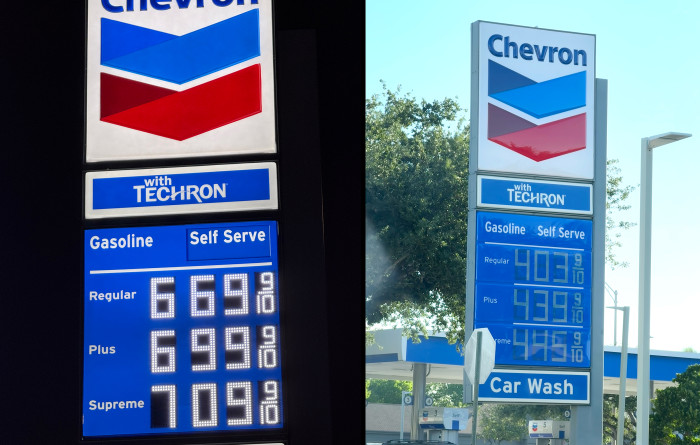
With generative AI tools now widely available, creating a convincing fake invoice, receipt, or bank statement takes minutes. The scary part? Most of these fakes don’t look suspicious at all. I was able to create a fake receipt in less than 5-minutes, take a look:
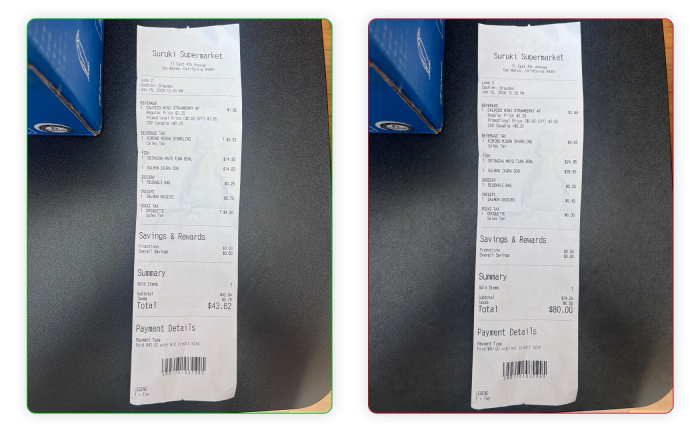
They’re real documents that have been subtly altered, a tweaked price here, a changed date or barcode there, and they’re designed to slip through undetected.
The question isn’t whether fake documents are being submitted to your workflow. The question is whether your system can actually catch them. Guess what!? We can!
How OCR-Powered Fraud Detection Actually Works
Every day, businesses that process invoices, receipts, bank statements, and financial records make real decisions based on uploaded documents. Whether it’s fintech document verification, lending document review, bank statement verification, or loyalty receipt validation, the volume is massive, and the stakes are real.
Pulling off document fraud has never been easier. Anyone with basic knowledge of Photoshop immediately becomes a threat. As the Entrust 2025 Identity Fraud Report notes, “To create digital forgeries, fraudsters are accessing document templates online or downloading images of documents obtained via a data breach and manipulating the details in Photoshop” (p. 18).
Modern invoice fraud detection and receipt fraud detection isn’t just about catching obvious fakes anymore. With AI document security threats evolving daily, fraudsters are using generative AI to produce synthetic documents that pass basic visual checks instantly. A legitimate receipt gets pulled into an editing tool, one number changes, and suddenly your document processing API is looking at something that reads as completely real but isn’t.
This is exactly where traditional OCR falls short. It’s a system without a brain (AI).
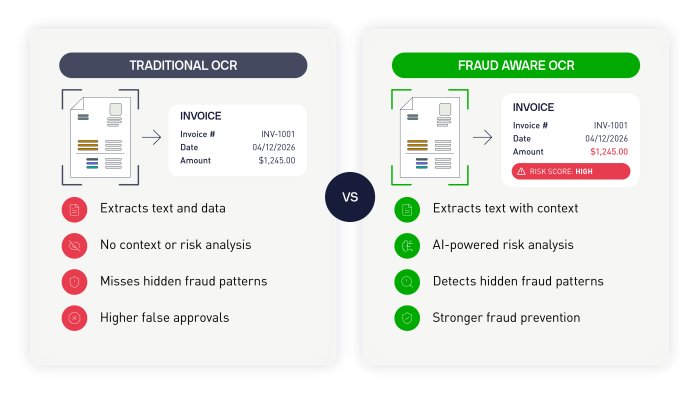
Standard OCR data extraction reads what’s on the document and stops there. No image tampering detection. No duplicate document detection. No synthetic document identification. Just raw extracted text moving forward into your workflow, fraud included.
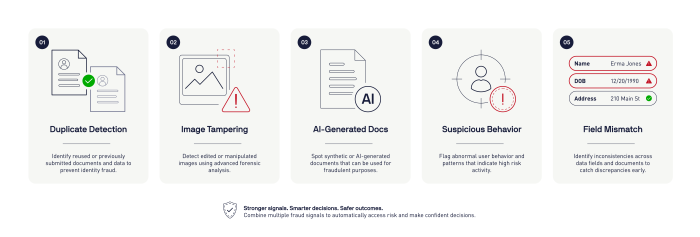
Veryfi’s fraud detection API works differently. It doesn’t sit downstream waiting. It operates at the OCR layer, the exact moment of upload, running every document through field mismatch detection, velocity-based behavioral rules, and AI-generated document detection before it ever touches your workflow.
Backend Developers
Every document entering your pipeline is a liability until proven otherwise. Fraudsters are now using AI to generate fake invoices and receipts that are virtually undetectable to the human eye, and traditional OCR isn’t built to catch them. Here’s what that means for your stack.
You’re the one building the pipeline that documents flow through. Right now, your system probably asks one question when a file gets uploaded: “Can we read this?” Veryfi lets you add a second question at that exact moment: “Can we trust this?” Drop it in as an API layer and suddenly every invoice, receipt, or document hitting your workflow gets checked for tampering, duplicates, and synthetic generation, before it ever moves forward. You built the door. Veryfi is the lock.
Fintech, Lending, or Banking
Your decisions are only as good as the documents behind them. With AI-generated fakes and subtly altered financial records now flooding document workflows, one missed fraud case can mean a bad approval or a compliance disaster. According to the Association of Certified Fraud Examiners (ACFE), organizations lose an average of more than $1.5 million per fraud case, with the median loss sitting at $145,000 and 22% of cases exceeding $1 million.
Your entire business runs on documents. Loan applications, invoices, bank statements, financial records, and every single one of them is a potential vector for fraud. One convincing fake that slips through can mean a bad approval, a wrongful payout, or a compliance nightmare. Veryfi catches altered documents, duplicates, and AI-generated fakes at the point of upload, so your decisions are based on what’s real, not what looks real.
Marketing & Rewards Programs
Every fake receipt in your campaign is money quietly walking out the door. At scale, even a small fraud rate can drain your entire budget before you notice it happening. Here’s what that means for your campaigns.
Someone always tries to game the system. People submit the same receipt twice, edit the totals, or generate fake ones just to grab the cashback or points. And when your campaign is running at scale, even a small fraud rate adds up fast and quietly drains your budget. Veryfi validates receipts automatically so every reward goes to someone who actually earned it, protecting your campaign budget without slowing down the experience for legitimate customers.
The Bigger Picture
Processing documents fast doesn’t protect you if what you’re processing can’t be trusted. Modern fraud doesn’t announce itself; it hides in edited pixels, reused files, synthetic layouts, and behavioral patterns that basic rule checks simply miss.
Veryfi builds fraud detection directly into the OCR layer, so by the time a document makes it into your workflow, it’s already been checked, analyzed, and either cleared or flagged. No human bottleneck. No slow review queue. No costly mistakes slipping through.
The real question isn’t “how fast can you process documents?”
It’s “how much are you losing to the ones you can’t catch?” As the Entrust 2025 Identity Fraud Report highlights, fraudsters are increasingly creating digital forgeries by “accessing document templates online or downloading images of documents obtained via a data breach and manipulating the details in Photoshop,” contributing to a 244% surge in digital document forgeries (p. 18)
If you want to see how OCR-powered fraud detection can protect your workflow before fraud leads to losses, explore Veryfi’s Fraud Detection Suite or talk to one of our experts.