




This is part of Ernest’s exploration of how documents shape our everyday lives and the experiences they create — and how, at the intersection with AI, this dynamic can be automated and transformed to reshape the world.
2 years ago I rolled up my sleeves and put together a new gas-powered pressure washer in my driveway (Thanks Lowes for the great buy!). If you sell products like this, the scene pictured below probably looks familiar from the other side of the transaction too — because whatever brand’s name is on the box, some version of what happened next is happening to a large share of your own buyers, most of whom will never tell you about it. Read on.
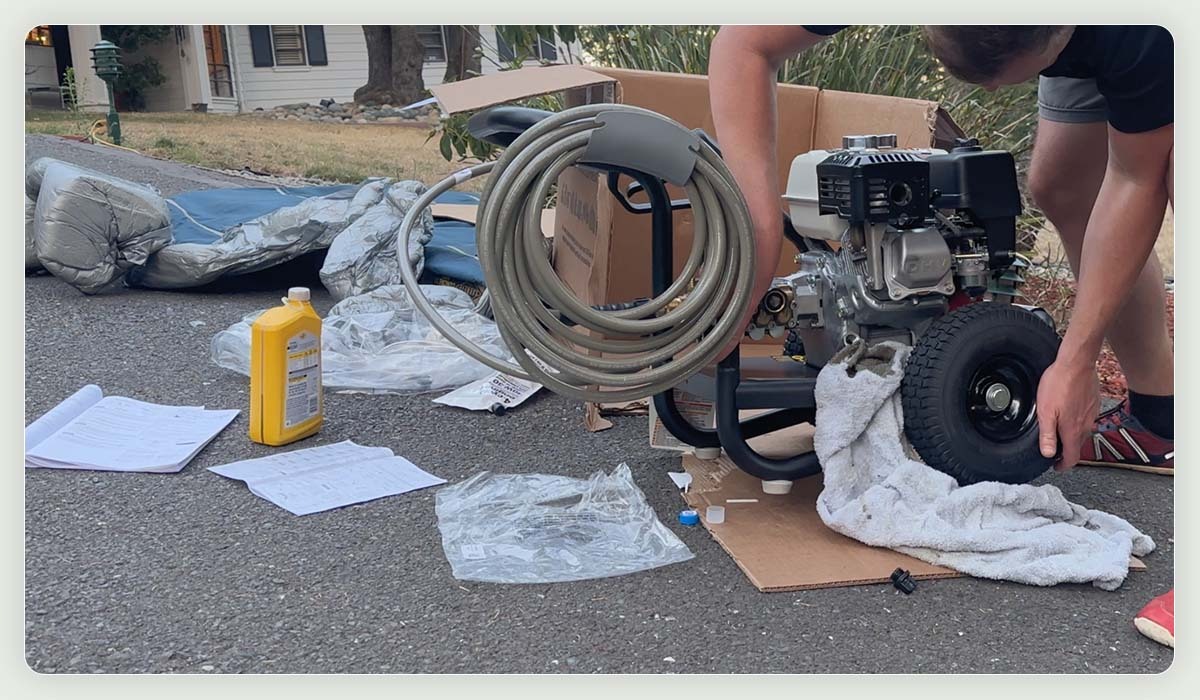
I didn’t register the product.
Not because I didn’t want the extra perks / warranty — I did — but because I pulled up the manufacturer’s registration page on my phone and looked at what it was actually asking for: full name, email, phone number, a complete mailing address with state and ZIP, where I bought it from a dropdown list, the purchase date, the product type, the model number, the serial number… ok information overload.. skipping..
I couldn’t help but think: this entire form could be two photos.
- Receipt photo: which already establishes proof of purchase, the purchase date, the retailer, and the product.
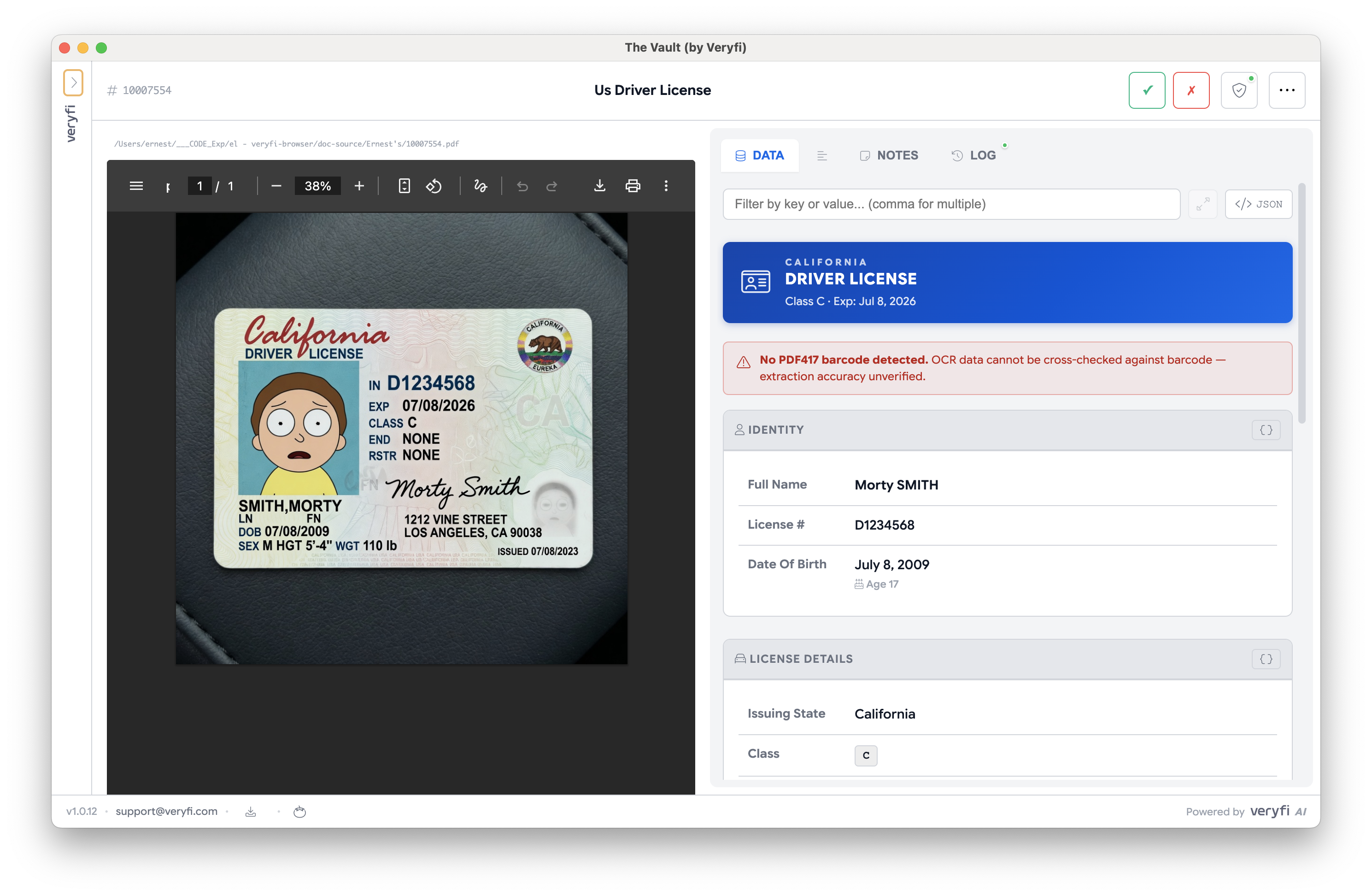
- Driver’s license photo: which establishes who I am, standardized and government-verified, formatted the same way every time.
Two pictures, taken in the time it takes to read this paragraph, instead of a dozen manually typed fields. Arrr… Simpson you listening 😉
That gap — between what registration could take and what it actually takes today — is the same gap that’s existed in one form or another for centuries. It’s worth understanding where it came from before looking at what it’s costing manufacturers now, and how to close it.
The Handshake Era of Ancient Times
For most of commercial history, a warranty wasn’t a document, it was a relationship. Long-distance traders relied on verbal promises, reputation, and the unwritten rules enforced by merchant guilds to guarantee the quality of goods changing hands. If a shipment of grain or cloth arrived damaged or short, there was no claims department to call. There was only the merchant’s word, and the guild’s willingness to enforce it, or not, on his behalf. The rise of global shipping forced the shift from spoken promises to written proof — bills of lading, contracts, and eventually the written warranty as we’d recognize it today.[^1]
That shift — from a relationship-based guarantee to a document-based one — is the hinge the rest of this history swings on. Everything that follows is really just an argument about what that document should say, who should have to prove what, and how.
The Problem
Registration forms have always been the best tool manufacturers had for solving a genuinely important problem: knowing who owns their products. That knowledge is the backbone of recall reach, warranty support, and product quality data — there’s no version of a good warranty program that doesn’t depend on it. For a long time, a card or a web form was simply the only practical way to build that record.
What hasn’t kept pace is the design of the tool.
And the numbers show it. Baseline registration rates sit around 15–30% for products with no incentive attached, climbing to 40–60% when brands sweeten the deal with an extended warranty offer.[^3]
For categories like outdoor power equipment and furniture specifically — the bucket a pressure washer falls into — the picture is worse: one widely cited University of Michigan study put registration intent at just 10.7–13.1%, compared to 56.3% for major appliances.[^3] A separate industry analysis puts the average registration rate across all categories at 38%, meaning roughly 62% of warranties are never registered by the end customer at all.[^3]
The form isn’t a rounding error in that gap — it’s most of it: on desktop, up to 44% of customers abandon a registration flow before finishing it, while flows that let customers register with a photo instead of typing have measured completion rates as high as 91%.[^4]
Receipts fade and disappear..
For decades, the thing that legally establishes coverage — the receipt — has also been the thing everyone is worst at keeping. Thermal receipts fade within weeks. Emails get buried. People upgrade phones and lose the photo they meant to take. Meanwhile, registration, even when completed, often sits in a database disconnected from any actual proof of purchase, meaning it doesn’t even solve the problem it was supposedly created for.
That mismatch is expensive for manufacturers in a very direct way. Without reliable ownership data, recall notices go to a fraction of actual owners, failure-rate analytics get built on incomplete and self-reported data, and warranty claims have to be taken largely on faith rather than checked against a verified purchase.
Every field a customer has to type by hand is a small, compounding reason for them to close the tab, the way I did.
The Veryfi Way
The best solution is not by asking consumers to do more paperwork, but by making the existing proof of purchase actually usable, and by replacing manual data entry with something a camera can already see.
1. Registration done with Pictures
A customer submits a photo of their receipt and drivers license using Veryfi Lens. Veryfi’s document intelligence extracts the line items, matches cryptic point-of-sale text, SKU & UPC against a real product catalog, and enriches it with the actual product name, SKU, model number, MSRP, and category.
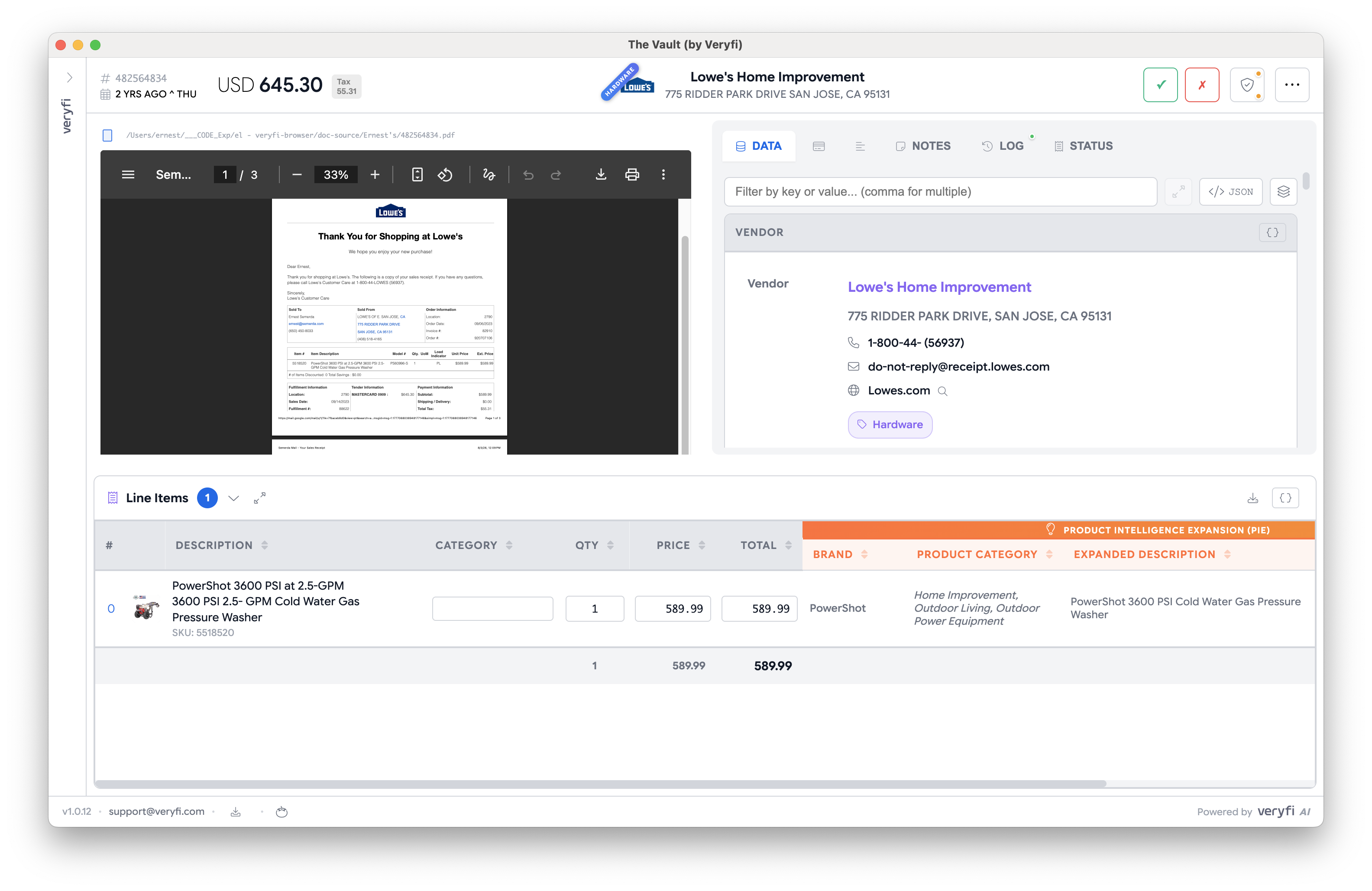
2. Unlock rich product data
That enrichment happens line by line, across the whole receipt. Products get matched and tagged with a warranty badge; non-product lines — a savings line, a charity donation — correctly get skipped, so the system isn’t trying to force a warranty match onto something that was never a product to begin with.
From there, Veryfi cross-references the purchase date and matched product against the manufacturer’s actual warranty policy — including handling the genuinely hard cases.
See how easy this is with Veryfi’s AI?
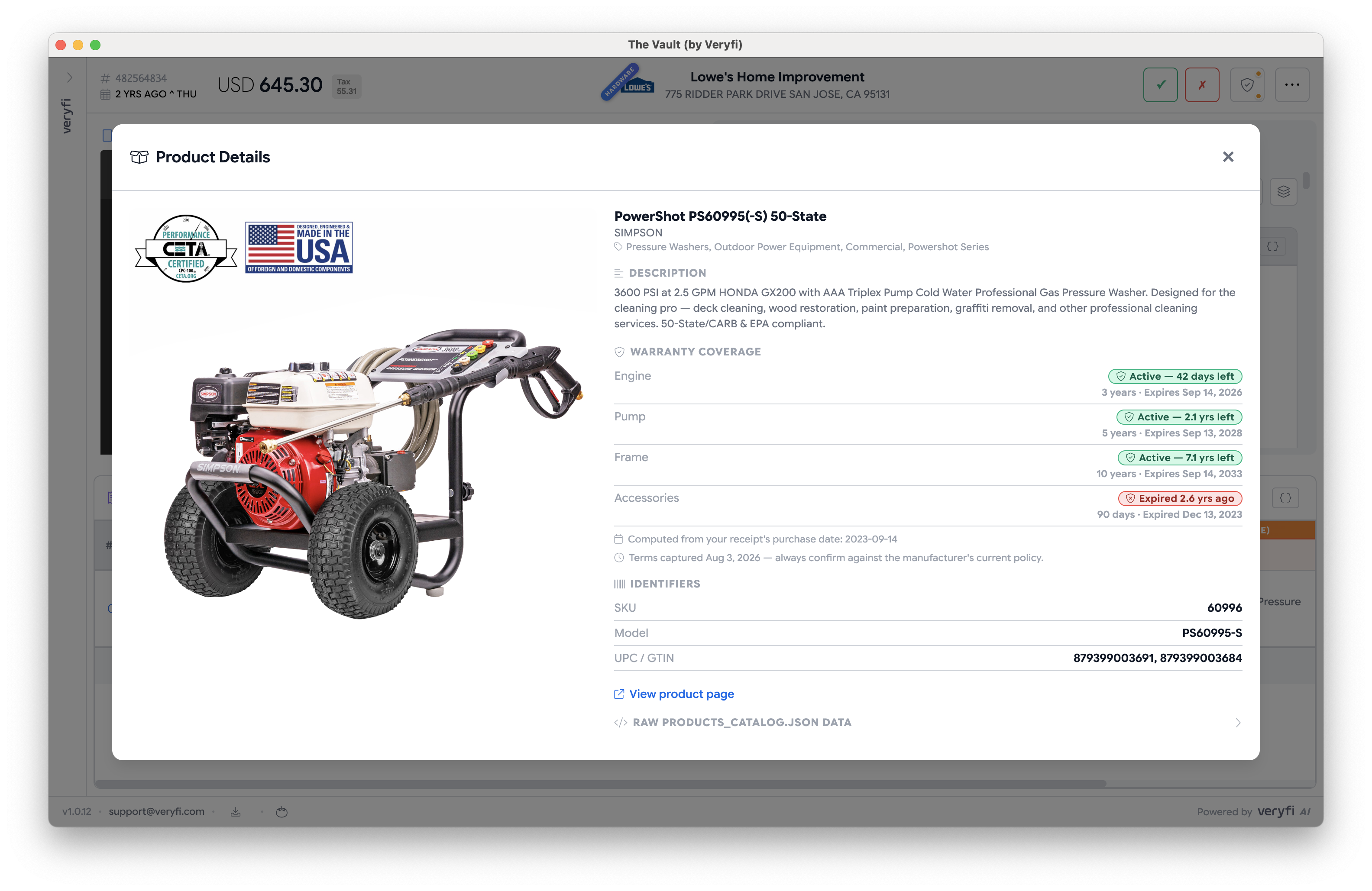
Unfortunately it’s too late for me to register my Simpson pressure washer but maybe not for you?
Under the Hood
Everything in the screens above comes out of a single API call against the receipt image. Here’s a trimmed, representative excerpt from that same response — the date, line items with product enrichment, and vendor detail, all pulled directly from the document rather than typed in by anyone:
{
  "vendor": {
    "name": "Lowe's Home Improvement"
  },
  "date": "2023-09-14 12:09:00",
  "invoice_number": "82910",
  "subtotal": 589.99,
  "tax": 55.31,
  "total": 645.30,
  "line_items": [
    {
      "description": "PowerShot 3600 PSI at 2.5-GPM 3600 PSI 2.5-GPM Cold Water Gas Pressure Washer",
      "quantity": 1,
      "total": 589.99,
      "sku": "5518520",
      "product_info": {
        "brand": "PowerShot",
        "category": ["Home Improvement", "Outdoor Living", "Outdoor Power Equipment"],
        "expanded_description": "PowerShot 3600 PSI Cold Water Gas Pressure Washer"
      }
    }
    ...
  ]
  ...
}
A few things worth pointing out in that response:
dateis parsed, not assumed. This is the field that actually starts the warranty clock in the screen above — extracted from the document itself rather than defaulted to an upload date.product_infois where the enrichment happens. Each line item’s raw, often-abbreviated description gets matched to a brand, a category path, and an expanded, human-readable description — the same data that powers the Product Details panel shown earlier.vendoridentifies where the purchase happened, which matters when a warranty policy varies by authorized retailer, or when a claim needs to be routed to a specific dealer.
The API also runs a consistency check across the document, not just an extraction pass. On this same receipt, it caught that the line items didn’t reconcile with the receipt’s stated totals, and surfaced that automatically instead of silently returning mismatched numbers:
"warnings": [
  { "type": "item_counts_mismatch", "message": "Total Items sold doesn't match number of line items" },
  { "type": "totals_mismatch", "message": "Subtotal for Line Items 5209.09 doesn't match subtotal on document 209.09" }
]
For a manufacturer using this data to activate coverage, that flag matters as much as the extraction itself. It’s the difference between quietly trusting a number that doesn’t add up and knowing to route a receipt for a second look before it becomes the basis of a warranty decision.
End User Benefits
For the customer, this collapses a multi-step chore into a single action they were probably going to do anyway. Instead of a form asking for name, email, phone, full address, retailer, purchase date, product type, model number, serial number, and a consent checkbox, the customer takes a picture of the receipt already in their hand, and, for identity verification, a picture of a driver’s license.
Two photos, taken in seconds, in the exact spot where I instead stood scrolling through a form field by field and consistent with the completion-rate gap above, that’s the difference between a flow nearly half of customers abandon and one over 90% finish.[^4]
It also solves the fading-receipt problem outright. Once a receipt is captured and processed, the actual purchase data — merchant, date, price, product — lives somewhere durable, independent of whether the thermal paper itself survives the next six months in a drawer. If a claim ever needs to be filed, the customer isn’t searching for anything. The system already knows what they bought, when, and whether it’s still covered.
Manufacturer Benefits
For manufacturers, this flips the economics of registration entirely. Instead of relying on a form that most customers abandon halfway through, brands get a much higher-fidelity signal: actual proof-of-purchase data captured with minimal friction, at the moment a customer is most willing to engage.
Recall reach. A recall notice is only as good as the contact list behind it. Real purchase data from a much larger share of buyers means safety notices reach the people who actually need them, instead of the 38% or so who completed a traditional form.[^3]
Product and failure analytics. Accurate ties between purchase date, product line, and claim rate — without the noise of self-reported, incomplete registration data — make it possible to actually see which batches, retailers, or regions are generating more claims than they should.
Fraud reduction. Warranty fraud is estimated to cost manufacturers on the order of $25 billion a year industry-wide, with fraudulent claims typically accounting for somewhere between 3% and 10% of total warranty costs.[^5] Matching claims against a verified receipt at the point of registration — rather than taking a typed-in claim at face value — closes off a meaningful share of that exposure before it happens.
Completion rates, not abandonment. A two-photo flow doesn’t lose customers halfway through the way a twelve-field form does. That matters most in exactly the categories — outdoor power equipment, tools, furniture — where registration intent is already lowest.[^3]
A better first touchpoint. A customer’s first real interaction with a brand’s support system becomes a fast, accurate warranty check instead of a frustrating form. That matters for loyalty: warranty-related emails see open rates around 75%, compared to roughly 21% for ordinary promotional email — customers pay attention when a brand’s outreach is actually useful to them, and a clean registration experience is the first chance to earn that attention.[^3]
The irony is worth sitting with: the Magnuson-Moss Act made clear, back in 1975, that the receipt — not the registration card — was always what actually mattered. It’s taken fifty years, and a form standing between a customer and a pressure washer’s warranty, for the industry to build a system that finally treats it that way.
Let’s Go!
If you run product registration, warranty operations, or customer experience for a consumer brand, the gap described here isn’t abstract, it shows up twice: once at the top of the funnel, in a completion rate well under half of what a photo-based flow achieves, and again downstream, whenever a claim comes in with no verified purchase record behind it.
Veryfi’s warranty check turns a receipt photo into that record automatically, matched against your product catalog and your actual warranty policy.
If you’re curious what that could look like against your own registration flow and warranty terms, reach out to the Veryfi team sales@veryfi.com to see it applied to your product line.
Got a similar story? Let me know.
Veryfi AI used:
[^1]: The History of Warranty Management, WarrantyHub
[^2]: Regulatory Statement, National Home Service Contract Association; The History of Extended Car Warranties, Endurance Warranty; US Congress Requires Product Warranties, EBSCO Research Starters; The History of the Magnuson-Moss Warranty Act, Ginsburg Law Group
[^3]: Warranty Registration: Why Brands Need It, Claimlane; Product Registration Statistics 2026, Bawte Learn (citing University of Michigan Transportation Research Institute, UMTRI-2015-26, and Clyde/Cover Genius email engagement data); Capture Warranty Registrations for Home Services, US Tech Automations (citing Gartner’s 2024 Customer Data Management Report)
[^4]: Use Warranty Registration Data for Content Marketing Strategy, Heinzeroth (citing Registria completion-rate research)
[^5]: E-Commerce Warranty Fraud: Edge Cases Hiding in Plain Sight, SureBright; Fraud Prevention in Warranty Claims, CodeWarranty