




Imagine pointing your phone at a prescription inhaler and in seconds knowing not just what drug it is, but its FDA approval history, every active ingredient down to the microgram, its full packaging hierarchy, its pharmacological class, and a complete set of identifiers ready to plug into any EHR or pharmacy system. No manual data entry. No barcode scanner hardware. Just a photo.
That’s exactly what we’ve built at Veryfi and added it to the The Vault.
A Single Photo. A Complete Drug Profile.
We’ve integrated the Veryfi Prescription Medication Label OCR API directly into The Vault, and it goes well beyond what you might expect from “label scanning.”
When you upload or photograph a medication bottle, The Vault doesn’t just read the text on the label — it decodes the barcode, extracts the National Drug Code (NDC), and then cross-references that code against FDA databases, NIH’s RxNorm, DailyMed, openFDA, and GS1 registries to return a rich, structured pharmaceutical profile.
RxNorm / RxNav resolve the NDC barcode → RxCUI → then pull packaging properties and clinical drug name
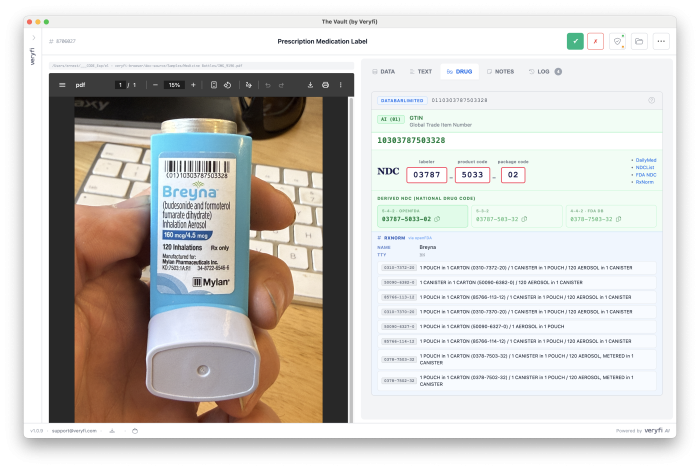
Pull the full FDA drug record (brand, generic, active ingredients, all identifiers)
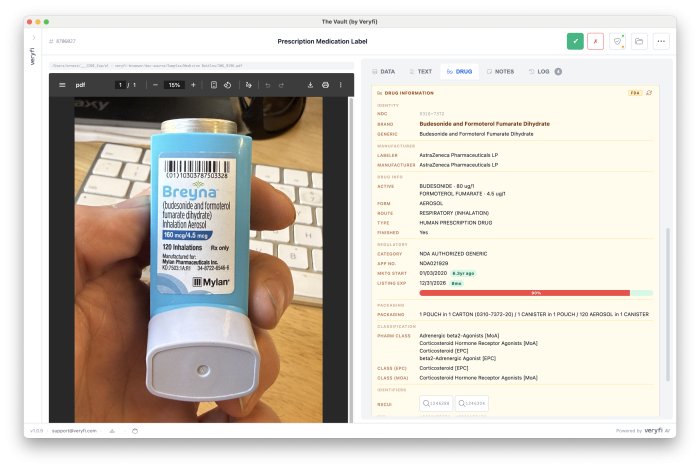
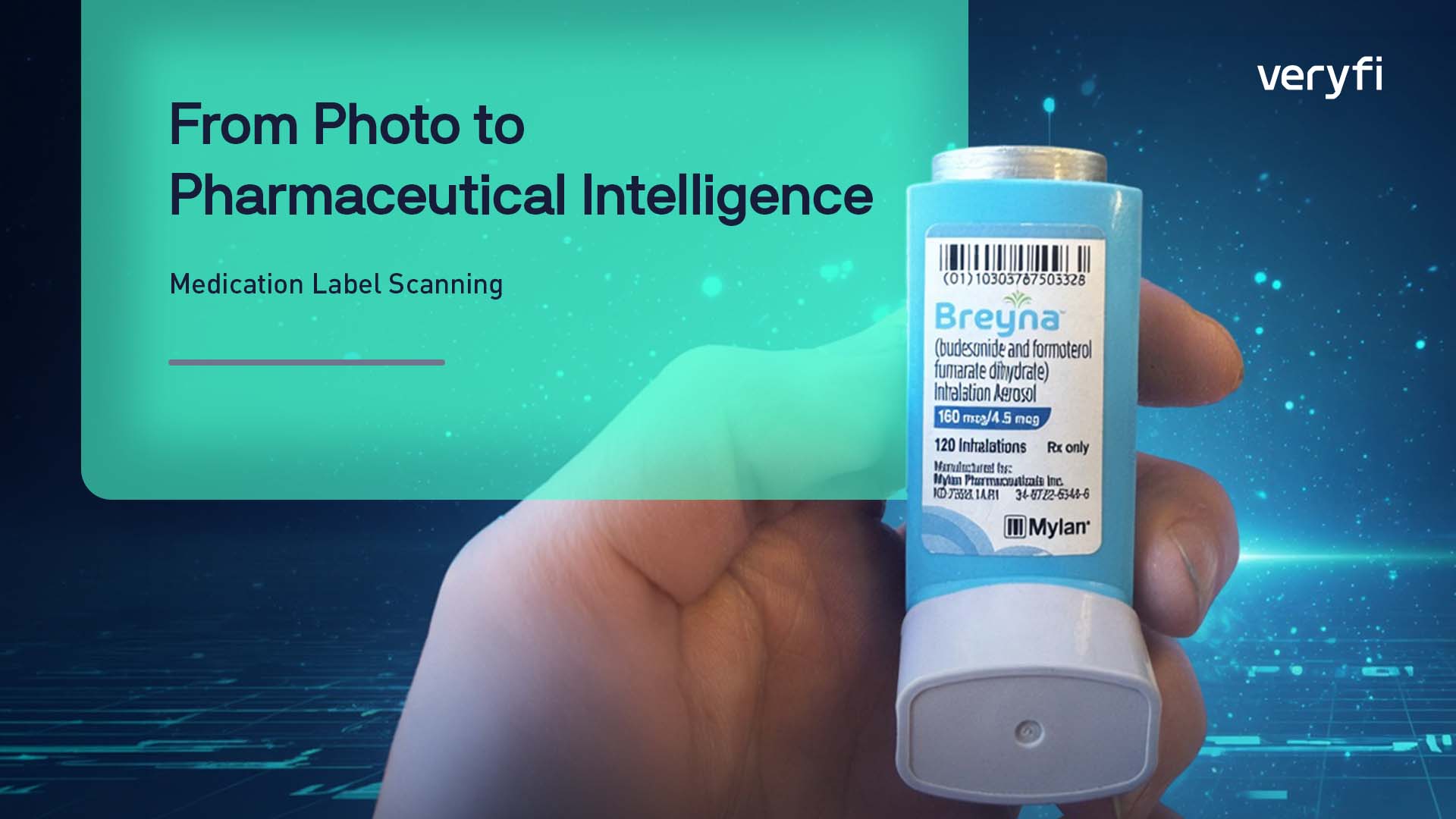
Take the Breyna inhaler in the screenshot above. From a single image, The Vault returned:
- Brand name: Breyna (budesonide and formoterol fumarate dihydrate)
- Manufacturer: AstraZeneca Pharmaceuticals LP / Mylan Pharmaceuticals
- Active ingredients: Budesonide 80 µg/1, Formoterol Fumarate 4.5 µg/1
- Form & route: Aerosol, Respiratory (Inhalation)
- Regulatory category: NDA Authorized Generic (NDA021929)
- Marketing start: January 3, 2020 — listing expires December 31, 2026
- Pharmacological class: Adrenergic beta2-Agonist, Corticosteroid Hormone Receptor Agonist
- Identifiers: RxCUI, SPL ID, UNII, NUI, and more
All of that from a photo of a bottle someone was holding in their hand.
What Gets Extracted — and Why It Matters
Drug Identity & Naming
Brand name, generic name, and RxNorm classifications are pulled directly from FDA databases. You’re never left guessing whether two drug names refer to the same compound — the system resolves it for you.
NDC Breakdown & Cross-References
The NDC isn’t just read — it’s parsed into its labeler, product, and package segments, then cross-referenced in every standard format (5-4-2, 5-3-2, 4-4-2) and linked to GTIN/GS1, openFDA, DailyMed, RxNorm, and the FDA NDC Directory. One code, every registry.
Active Ingredients & Dosage
Every active ingredient is extracted with its precise dosage and unit — the kind of clinical-grade detail that matters for formulary management, insurance processing, and compliance documentation.
Form, Route & Drug Type
Dosage form (aerosol, tablet, capsule), administration route (inhalation, oral, topical), and drug classification (human prescription, OTC, biologic) are all captured and structured automatically.
Manufacturer & Labeler
Full identification of manufacturer and labeler, including whether the product is an original packager or an authorized generic — a distinction that matters enormously in PBM contracting and reimbursement workflows.
Regulatory & Market Data
FDA application number, marketing start date, listing expiration, and regulatory category (NDA, ANDA, authorized generic) give you a drug’s full approval history at a glance. No more digging through FDA.gov.
Packaging Configuration
The complete packaging hierarchy is extracted and structured — for example, “1 Canister in 1 Pouch in 1 Carton / 120 Aerosol doses per Canister” — across all known NDC package variants. This is critical for supply chain, receiving, and inventory accuracy.
Pharmacological Classification
Mechanism of Action (MoA) and Established Pharmacologic Class (EPC) tags — like “Adrenergic beta2-Agonist” or “Corticosteroid Hormone Receptor Agonist” — are structured for downstream clinical categorization and analytics pipelines.
Unique Drug Identifiers
SPL Set ID, SPL ID, RxCUI, UNII, NUI, and Product ID are all extracted and available for integration with EHR systems, pharmacy management platforms, and PBMs. Essentially, if your system needs a drug identifier, it’s probably in here.
Every Barcode Format You’ll Actually Encounter
A medication bottle in the real world isn’t a clean, controlled environment. You’ll see 1D barcodes and 2D codes, retail formats and hospital supply-chain formats, legacy encodings and DSCSA serialization — sometimes several on the same label. The Vault handles them all.
Retail / Outpatient
| Barcode | Format | Coverage |
|---|---|---|
| UPC-A | 1D, 12 digits | ✅ Full NDC decode + drug lookup |
| UPC-E | 1D, 8 digits | ✅ Full (compressed UPC-A on small OTC packages) |
Pharmacy / Hospital
| Barcode | Format | Coverage |
|---|---|---|
| Code 128 | 1D | ✅ Full — plain NDC, common on dispensing labels |
| GS1-128 | 1D | ✅ Full — GTIN + Expiry + Lot + Serial |
| DataBar Limited | 1D | ✅ Full — GTIN on small unit-dose packages |
| DataBar Expanded | 1D | ✅ Full — GTIN + Expiry + Lot + Serial |
| ITF | 1D | ⚠️ Partial — numeric data only |
| Code 39 | 1D | ⚠️ Partial — numeric NDC or raw alphanumeric |
Serialization / Track & Trace (DSCSA)
| Barcode | Format | Coverage |
|---|---|---|
| GS1-128 | 1D | ✅ Full — manufacturer cartons and cases |
| GS1 DataMatrix | 2D | ✅ Full — unit-of-use packages (DSCSA compliant) |
| QR Code | 2D | ⚠️ Partial — GS1 Digital Link URLs only |
Controlled Substances / Special Tracking
| Barcode | Format | Coverage |
|---|---|---|
| GS1 DataMatrix | 2D | ✅ Full — REMS drugs and high-risk medications |
| PDF417 | 2D | ✅ Full — REMS drugs and high-risk medications |
For the formats that support it, expiration date, lot number, and serial number are also extracted — which means The Vault can support DSCSA track-and-trace workflows without any additional hardware or middleware.
Built for Real Pharmaceutical Workflows
This isn’t a party trick. The data The Vault extracts is structured, normalized, and ready for integration with the systems healthcare organizations actually use:
- EHR integration — RxCUI, SPL ID, and UNII map directly to medication records
- PBM & formulary management — NDC cross-references and authorized generic flags for claims adjudication
- Pharmacy & hospital receiving — Packaging hierarchy and serialization data for DSCSA compliance
- Clinical analytics — MoA and EPC classifications for population health and utilization reporting
- Regulatory documentation — FDA app numbers, marketing dates, and listing expirations for audits and compliance
Try It in The Vault
You can try the medication label scanner today inside The Vault or directly via our API. Upload a photo of any prescription medication bottle, and watch the full pharmaceutical profile come back in seconds.
For developers and teams looking to build this capability into their own workflows, the underlying API is available through Veryfi’s Prescription Medication Label OCR API.
The era of manual medication data entry is over.