




Bank Check Fraud: A Growing Challenge
Check fraud continues to be one of the most costly threats facing banks, fintechs, and businesses processing payments at scale. Fraudsters today exploit every stage of the check lifecycle by submitting AI-generated checks, photographing legitimate checks to reuse digitally, or flooding systems with duplicates to slip past manual review. Traditional rule-based detection struggles to keep pace with the increasing volume of fraud, and accuracy remains a challenge.
Check fraud isn’t a niche concern – it’s a growing financial threat that’s not slowing down anytime soon. According to Nasdaq’s 2024 Global Financial Crime Report, check fraud losses in the Americas reached nearly $21 billion, accounting for 80% of global check fraud losses. The 2024 AFP® Payments Fraud and Control Survey named checks the payment method most vulnerable to fraud, with 65% of organizations reporting check fraud activity in the prior year. FinCEN issued a separate alert warning financial institutions about a surge in AI-generated documents being used to circumvent identity verification and payment controls.
Solving this requires more than updated rules or better manual review but it demands detection that operates at the same layer where fraud is introduced: the moment a check image enters the system. That means analyzing the document itself, the device it was captured on, and the data it contains and all in real time, before any transaction is processed. This is exactly the gap Veryfi’s Fraud Detection & Prevention Suite was built to close.
Sample Test with Veryfi customers
We decided to look at our own data. Working with a group of customers, we pulled a sample of 200,000 real-world checks processed through Veryfi’s system and ran them through our full Fraud Detection & Prevention Suite. Out of 200,000 checks scanned the system flagged 16,664 checks (7%) as fraudulent, protecting against $7.38M in potentially fraudulent check value.
Aspect ratio mismatch was the most common fraud type by volume (9,493 checks, 57% of all fraud), typically indicating tampered or digitally altered checks. However, AI-generated checks, while fewer in number (1,983), carried the highest average value per check at $1,026, making them the highest-risk fraud type per incident.
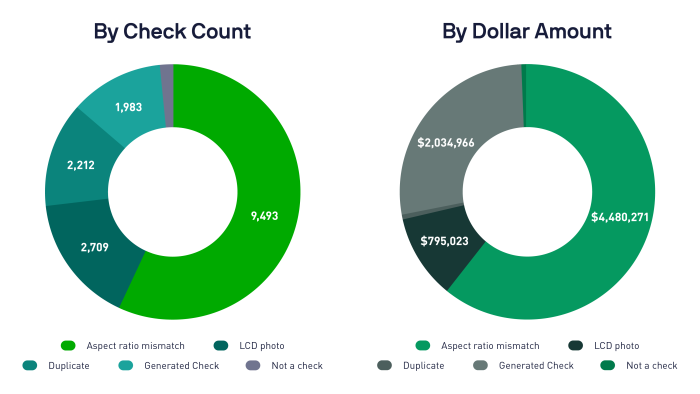
LCD photo fraud (photos of screens submitted as checks) and duplicates were significant in count but lower in dollar impact. The near-zero average per duplicate ($14) suggests opportunistic low-value resubmissions rather than sophisticated fraud.
| Fraud type | Checks | % of total | Amount (USD) | Avg per check |
|---|---|---|---|---|
| Aspect ratio mismatch | 9,493 | 4.93% | $4,480,271 | $472 |
| LCD photo | 2,709 | 1.41% | $795,023 | $293 |
| Duplicate | 2,212 | 1.15% | $31,464 | $14 |
| Generated check | 1,983 | 1.03% | $2,034,966 | $1,026 |
| Not a check | 267 | 0.14% | $34,001 | $127 |
| Total fraudulent | 16,664 | 7.00% | $7,375,725 | $443 |
Conclusion
The $7.38M in fraud caught across 200,000 checks isn’t just a sample number – it’s a proof point that modern check fraud requires a modern defense. As fraudsters increasingly lean on generative AI to fabricate documents and exploit gaps in legacy rule-based systems, financial institutions and fintech companies need detection that operates at the same level of sophistication. Veryfi’s Fraud Detection & Prevention Suite is built for exactly this moment: combining document authenticity analysis, duplicate identification, and real-time GenAI detection into a single API that works at the point of collection. Whether you’re processing thousands of checks a day or building the next generation of mobile deposit infrastructure, Veryfi gives you the coverage, accuracy, and speed to stay ahead of fraud at scale.
Contact our experts team for a quick product demo or sign up for a free Veryfi account at veryfi.com to get started.