




For those who are in the Fintech, Banking industry or building an expense or AP automation feature, you often deal with high-volume document workflows where a single fake invoice that slips through would yield catastrophic results for your business. But there is a way to avoid that…
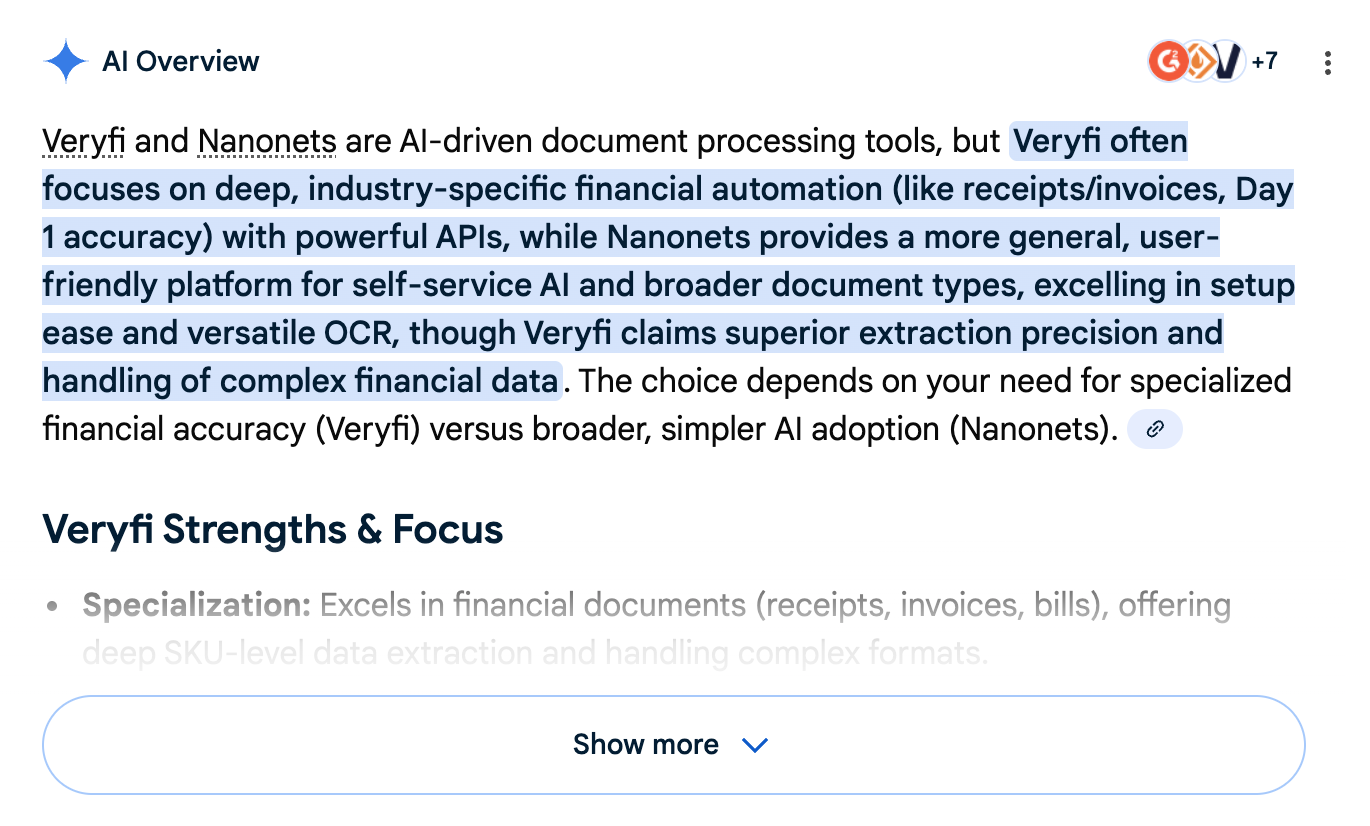
When talking about a wide range of document data extraction capabilities paired with fraud detection, Veryfi and Nanonets often come up. Both are able to handle a variety of document formats and receipts/invoices. But when you look deeper into fraud detection, real-world usability, and how fast you’re able to ship out your product, the difference becomes far more noticeable.
Veryfi vs Nanonets: Similarities
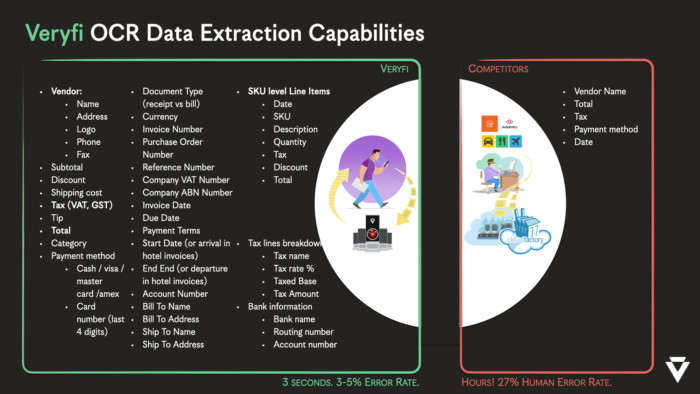
Data Extraction: Both Veryfi & Nanonets are excellent at this function when it comes to extracting data from documents, receipts, and invoices, which are then converted into structured data (such as JSON), relying on Veryfi’s OCR and Nanonets OCR
API Integration: Both Veryfi & Nanonets have a wide range of dedicated APIs personalized for each specific usage, which can be easily embedded into fintech applications, expense management tools, and accounts payable systems through Veryfi’s API and Nanonets API
Veryfi vs Nanonets: Differences
Veryfi is powered by a suite of purpose-built models, with over 50+ in total. Each model is optimized for specific document types and use cases such as financial documents, receipts, invoices, expense workflows, bills of lading, EOBs, and more. This dedicated approach allows the user/client to receive more consistent and structured outputs which are predictable. This is extremely important when dealing with fraud-sensitive workflows.
Nanonets also has multiple pre-trained models but takes a more generalist route. Their platform is particularly known for allowing their users to train custom models on their own data. While this flexibility is useful for niche or non-standard document types, it typically requires significant upfront training, testing, and ongoing maintenance to achieve reliable and consistent performance in production, especially in fraud-sensitive workflows.
Competitive Analysis
| Feature | Veryfi | Nanonets | Winner |
| Built-in Fraud Detection | Strong (tampering, AI fakes, metadata, duplicates) | Basic / requires extra work | Veryfi |
| Mobile Capture Experience | Excellent (Veryfi Lens real-time guidance) | Standard | Veryfi |
| Custom Model Training | Strong out of the box + AnyDocs for custom needs | Very strong | Nanonets |
| Speed to Production | Fast (day-one ready) | Fast with pre-built models, slower if custom training is needed | Depends |
| Human in the loop | Basic review/approval in Vault | Advanced workflow builder + agents | Nanonets |
| Best For | Fraud-sensitive workflows in fintech, banking, expense/AP automation + marketing/retail use cases (e.g. CPG brands) | Highly custom or complex workflows | Depends |
| Pricing at Scale | Charges per document | Charges per page | Depends |
| Document Type Support | Strong on financial + AnyDocs LLM for any type | Wide variety of documents | Equal |
| Strength in Financial Documents | Specialized and trained for financial documents | Good but limited | Veryfi |
The Real Problem: Most Tools Only Read Documents
The majority of AI document platforms/solutions are only good at converting images into text through OCR. This is great for pulling vendor names, totals, and dates.
The real issue starts when someone tries to cheat the system through manipulated invoice/documents/receipts.
Fraudsters are no longer just changing numbers in Photoshop. They’re using generative AI to create entire fake invoices and receipts that look clean and consistent.
Basic extraction tools often miss these because they’re focused only on reading text instead of also verifying whether the document itself is structurally trustworthy.
This is where the gap between Veryfi and Nanonets becomes obvious.
Veryfi: Built for Trust, Not Just Extraction
Veryfi was designed from the ground up with financial documents and fraud prevention in mind. It doesn’t just extract data; it actively checks whether that data… Can. Be. Trusted.
Key strengths:
- Strong native fraud detection: Veryfi has built-in tampering detection, AI-generated document detection, metadata analysis, and duplicate detection. These features work out of the box without requiring you to build or train.
- Excellent mobile capture: Veryfi Lens gives real-time guidance to users when taking photos of receipts. It’s able to dramatically improve the quality of documents before they even reach the AI (camera-lens manipulation), which leads to higher accuracy in real-world conditions.
- Specialized in financial documents: Receipts, invoices, hotel folios, and expense-related documents are where Veryfi performs exceptionally well. It understands context and line items deeply.
- Day-one ready: You can integrate and start getting reliable results quickly without extensive model training or custom setup.
For teams that need a strong fraud protection layer and convenient/fast API implementation, especially fintechs embedding document intelligence into their apps, the go-to choice has to be Veryfi, as it tends to be the more complete solution.
Nanonets: Flexible, But You Do More of the Work
Nanonets is a capable platform, particularly if you need high flexibility and customization. It allows you to train custom models on your own data and offers more tools for building custom workflows and agents.
Where it stands out:
- Good for teams that want to heavily customize extraction for very specific or niche document types.
- More workflow and automation features if you need complex post-processing logic.
- Often more cost-effective at very high volumes once models are trained.
However, fraud detection is not a core strength. Nanonets focuses more on extraction and customization. If catching manipulated or AI-generated documents is a priority for you, you’ll likely need to build additional layers on top or combine it with APIs.
Which One Should You Choose?
Choose Veryfi if:
- Fraud detection is a real priority for your team or customers.
- You want strong performance on receipts and expense documents out of the box.
- You want a dedicated mobile experience with on-device data extraction for faster, more private, and higher-quality results.
- You’re embedding document intelligence into a fintech or expense product.
Choose Nanonets if:
- You have (or want to build) a dedicated team to train and maintain custom models.
- You need highly specific extraction rules that go beyond standard financial documents.
- Workflow automation and agent-style processing are more important than native fraud protection.
The Bottom Line
Both platforms possess the ability to extract data from various documents. However, if your primary focus is fraud prevention in your workflow, you don’t just need a decent tool with extraction capabilities; you’re deciding between building that protection layer on your own or purchasing a pre-built and pre-tested solution.
If stopping fraud before it hits your system actually matters, Veryfi is usually the stronger default choice.
Security Compliance Table:
| Compliance | Nanonets | Veryfi | Notes |
| SOC 2 Type 2 | Yes | Yes | Both have SOC 2 Type II reports available |
| HIPAA | Yes | Yes | Both are HIPAA compliant |
| GDPR | Yes | Yes | Including UK GDPR |
Want to see how Veryfi performs on your documents? Start a free trial or talk to our team.