The Case of the Canadian Breakfast Bill
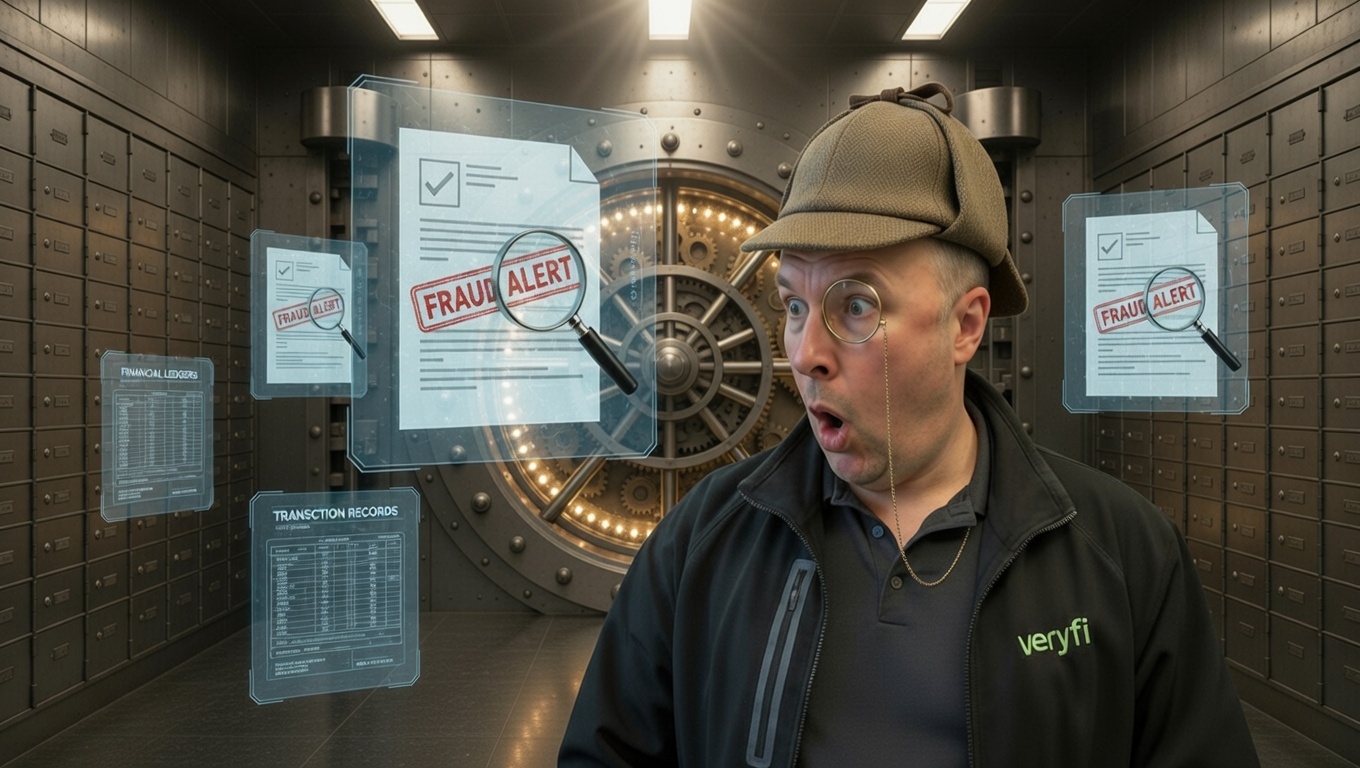
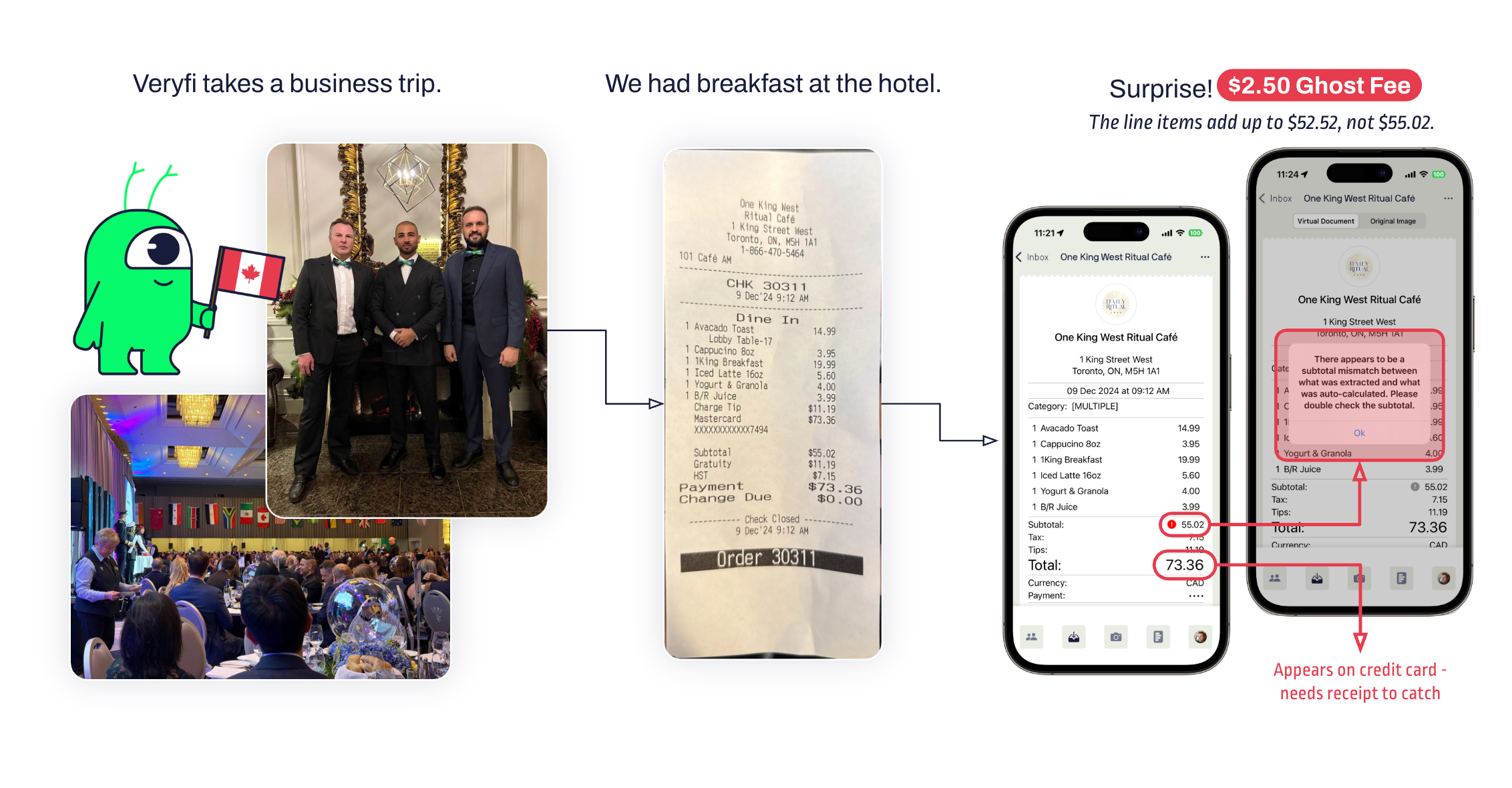
Erlock Holmes, on a rare business jaunt to Toronto with two colleagues, settled into the One King West hotel café for what should have been a straightforward breakfast. The trio—dressed sharply for the day’s meetings—enjoyed avocado toast, cappuccinos, iced lattes, yogurt with granola, and fresh juices amid the morning buzz. When the receipt arrived, Holmes glanced at it, frowned, and passed it around. “Gentlemen,” he murmured, “observe the subtotal: $55.02. Yet the line items sum precisely to $52.52. A $2.50 discrepancy… floating like a ghost in the fog.”
The others checked their phones; the Veryfi app had already snapped the receipt, extracted every detail, flagged the mismatch, and highlighted the phantom charge in red. Holmes leaned closer, pipe unlit. “No mathematical error here—someone has padded the bill. A classic overcharge, subtle enough to slip past most, but not past deduction… or modern OCR.” He signaled the server with a polite nod. Moments later, after a quiet word with the manager, the $2.50 “ghost fee” vanished from the final total. The breakfast was comped as an apology.
Back at the table, Holmes pocketed the corrected receipt. “Elementary, my friends. The restaurant attempted a small swindle, but receipts don’t lie when read by the right eye—or the right app. Next time, Justson, remind me: even in Canada, never trust a subtotal you haven’t double-checked with Veryfi.”
“When you have eliminated the impossible, whatever remains, however improbable, must be the truth.”
Just as Erlock Holmes relied on keen observation and logic to uncover deception, Veryfi brings that same deductive rigor to the modern world of expense management and document processing. In an era where fraudsters wield AI to craft near-perfect forgeries, Veryfi’s Fraud & Document Integrity Checks stand as a masterclass in real-time detection—powered by advanced AI, vision models, and multi-layered analysis.
Fraudsters may believe they are invisible, slipping altered receipts or AI-generated fakes into expense reports. They are not. Every manipulated pixel, suspicious timestamp, implausible figure, or behavioral anomaly becomes a clue that Veryfi solves instantly—at the very point of entry, before the damage is done.
Watch & Learn
Fraud & Document Integrity Checks
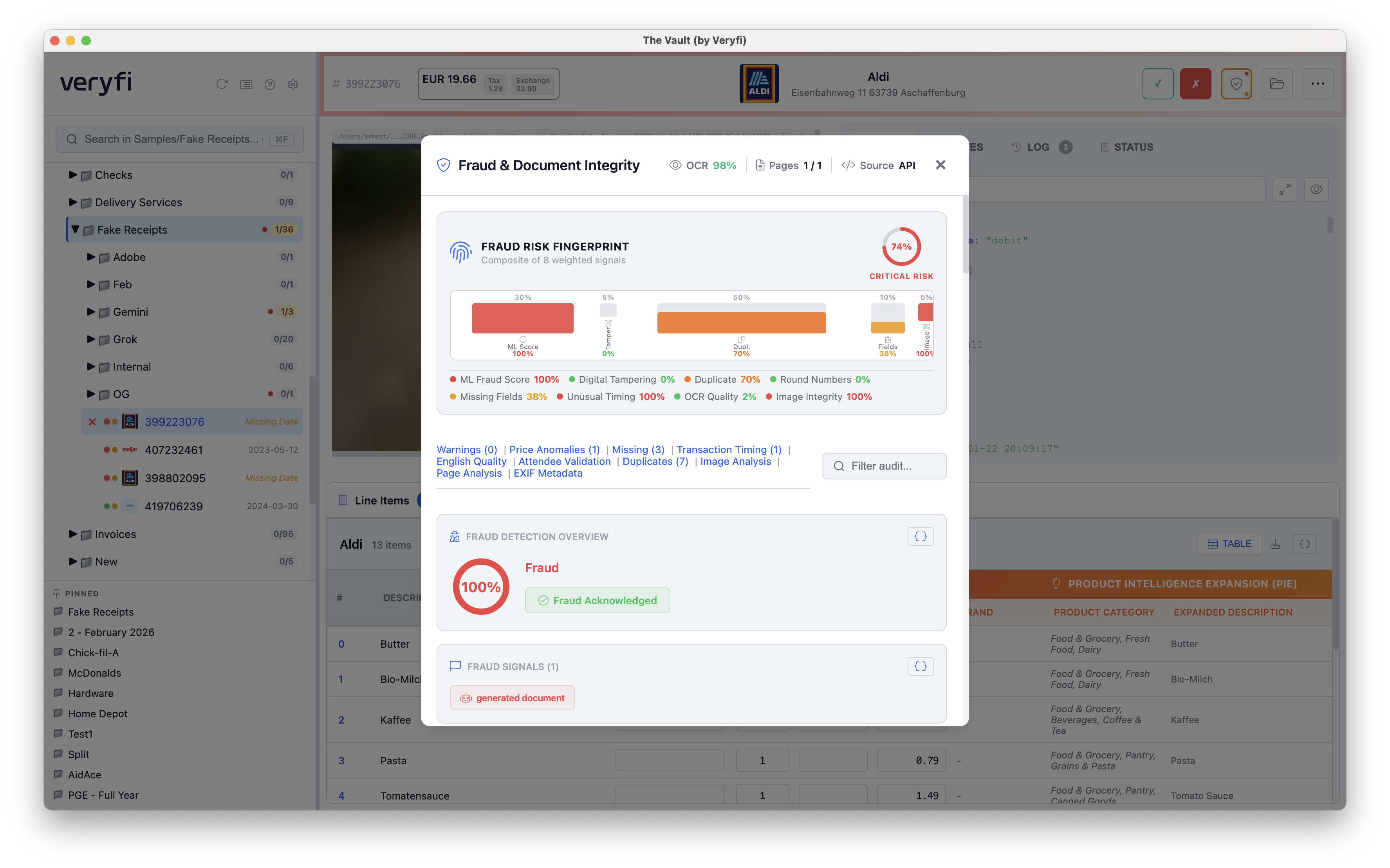
In a recent demonstration by Veryfi co-founder Ernest, viewers witness this powerhouse in action through the Veryfi Vault interface. Using real and fabricated receipts, the system performs 16 meticulous investigations on every document processed via the Veryfi API.
Glimpse into the detective work
- A legitimate Burger King receipt sails through with a clean bill of health on most fronts: no AI generation, normal transaction timing, and solid completeness—though flagged as a duplicate (processed multiple times) and missing a minor field like a “thank you” message. The interface shows a green dot for no fraud risk and an orange dot for warnings needing review. Ernest approves it with confidence.
- Contrast that with an LLM-generated fake receipt: the ML model immediately flags it as AI-created. Price anomalies scream foul (one item 217% above the median), document completeness drops to 63% (missing date and card details), and multiple other signals pile up. The system demands acknowledgment—the receipt is rejected outright.
Other highlights include
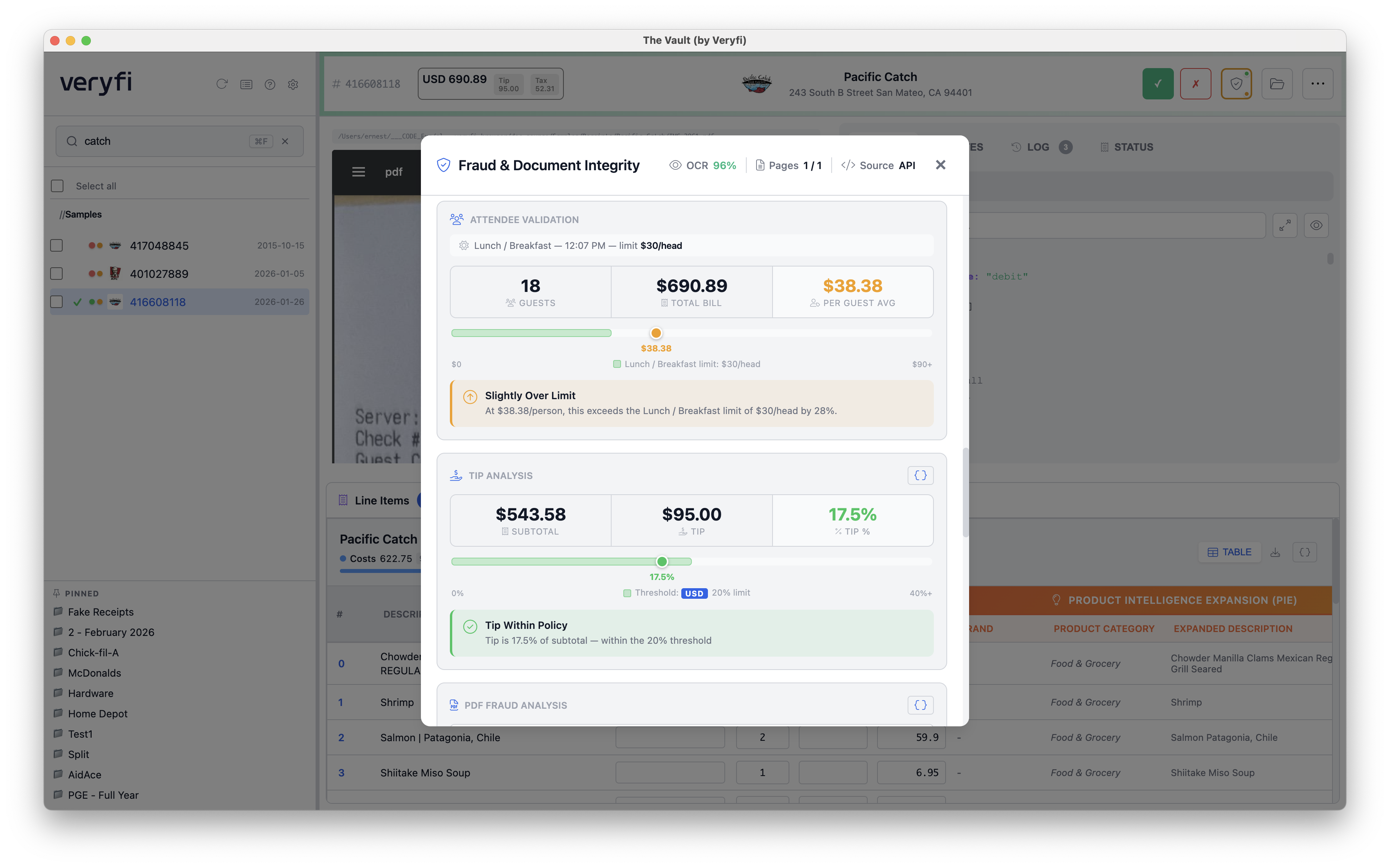
- Attendee validation on a Pacific Catch receipt with 18 guests: average spend hits $38 per head, exceeding the configured $30 lunch limit (before 5 PM) and triggering a warning.
- Tip analysis by country: A demo flags excessive tips (over 5% in Colombia) or adheres to U.S. norms (up to 20%).
- Line item warnings for repeats (e.g., the same artisan burger fries appearing twice—often benign but worth checking).
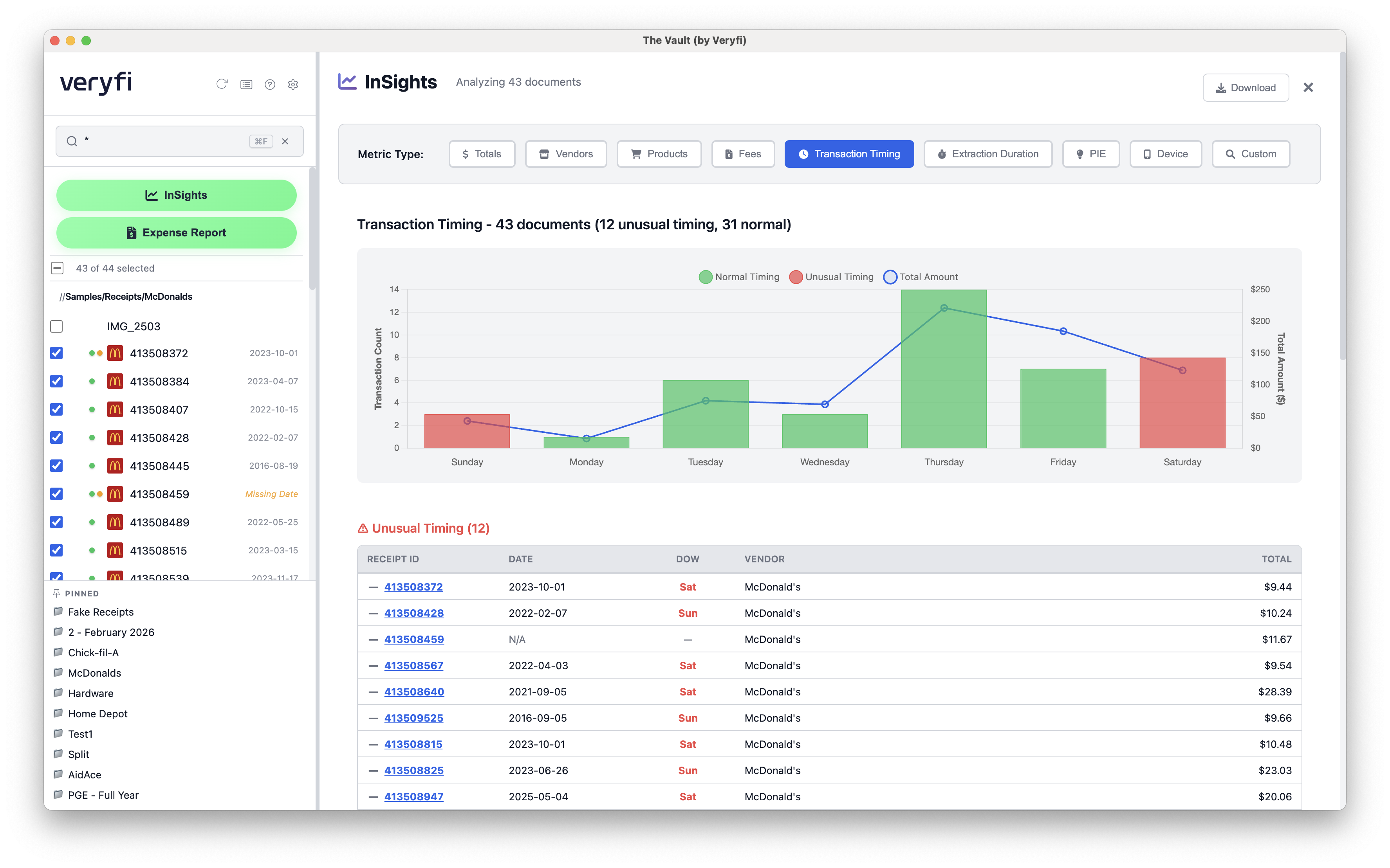
- Transaction timing analytics: A batch of McDonald’s receipts reveals a quirky Thursday pattern—harmless personally, but a red flag for weekend business-card use without travel.
These checks—spanning AI-generated document detection, digital tampering & image forensics, duplicate & similarity checks, PDF/EXIF metadata scrutiny, price anomalies & round-number alerts, submission velocity & device fingerprinting, handwritten field validation, and more—run automatically. Users customize weights (e.g., 30% on ML fraud score) and thresholds via configuration.
The result? Proactive protection that catches fraud in real time, reducing risk dramatically while streamlining approvals for legitimate documents.
Veryfi turns receipts from mere paper trails into forensic evidence. Whether you’re battling padded bills, AI fakes, or policy violations, the game is afoot—and Veryfi is already several steps ahead.
Ready to deploy your own fraud detective?
APIs Used
- Veryfi Lens for seamless document capture:
- Receipts OCR API for powerful extraction
- Fraud Detection Suite to activate these checks
The fraudster’s tricks may evolve, but with Veryfi, the truth emerges—elementary.