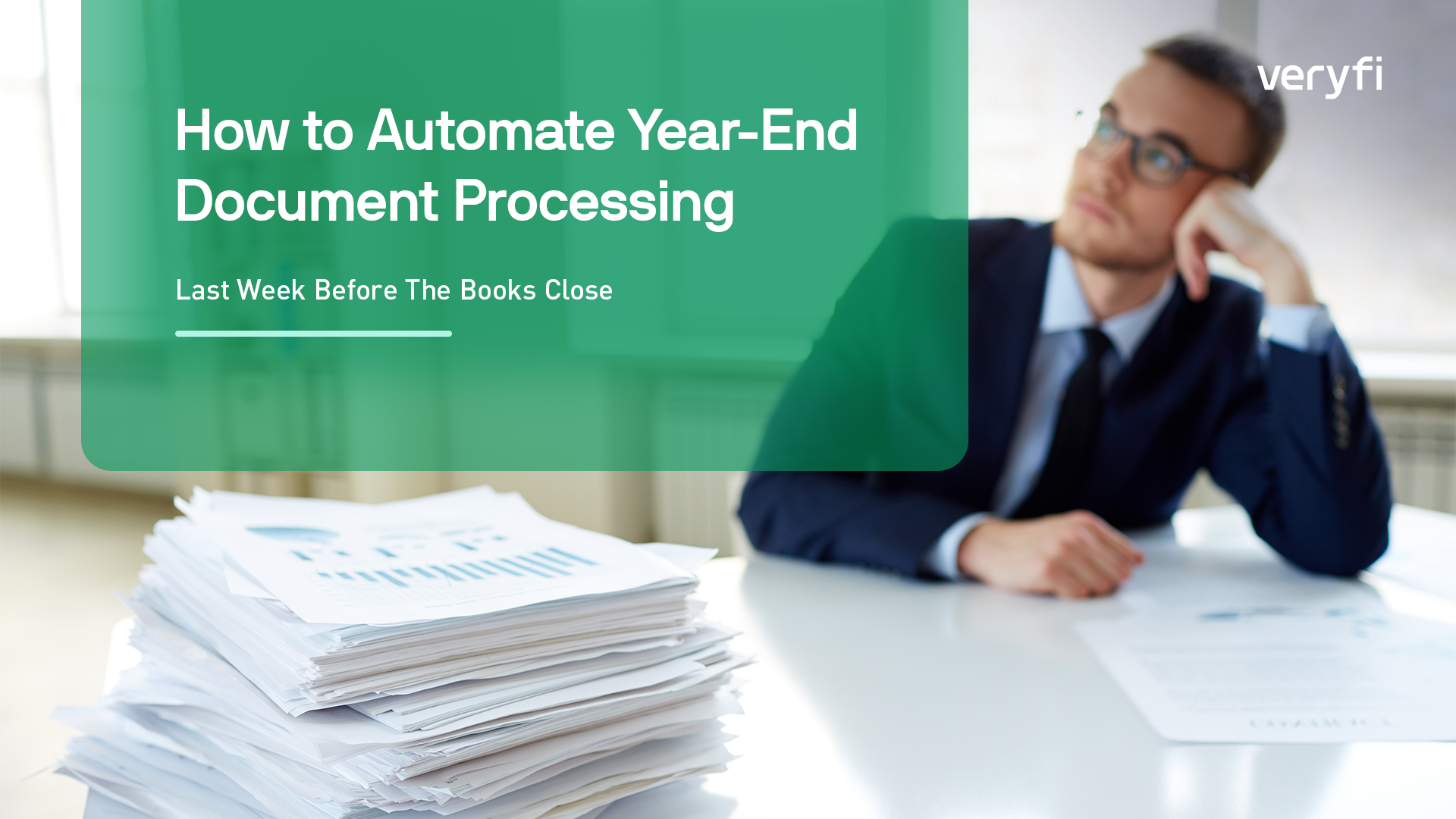


Wrapping up the year means the finance team is hunting down three invoices that may or may not exist. Someone emailed a receipt photographed in the dark. Someone else uploaded the same bill twice. The W-9 is from 2019, and confirming whether the vendor still uses the same legal entity takes time.
What else is there to say besides, “Happy holidays”?
Year-end close becomes stressful not because of accounting, but because documents have arrived through different channels, in the wrong formats, or with missing information all year where it’s only being taken care of now.
What actually piles up over the year
Across a typical business, documents accumulate in every direction:
- Vendor invoices
- Employee receipts
- Bank statements
- Purchase orders
- Credit memos
- W-9s and other tax documents
- Reimbursement backup
Some files are as PDFs; others as screenshots, email attachments or forwarded with no subject line.
Then December arrives and the top five questions that need to be answered:
- What type of document is this?
- Which vendor or employee does it belong to?
- Has it already been submitted?
- Is anything missing?
- Where does the extracted data go?
From a small batch of documents this can be sorted in no time, but when dealing with hundreds or thousands, the workflow experiences a bottleneck right around the end of the year.
The real bottleneck is unstructured data
Accounting systems prefer structure like so: vendor name, invoice number, date, total, tax, line items, payment terms, PO number.
These documents do not arrive as spreadsheets rows. They arrive as email attachments, images, various types of files which still need to be opened, read, and classified accordingly.
Here’s the thing, Veryfi’s API can extract over 150 fields including vendor details, dates, totals, payment info, taxes, line items and return all of them as structured data which can be fed directly into all types of AP workflows. Allowing you to skip rekeying entirely.
Why waiting until December doesn’t work
The standard year-end cleanup goes roughly like this:
- Chase employees and vendors for missing documents.
- Download files from multiple inboxes and portals.
- Rename and sort everything.
- Enter data into spreadsheets or accounting software.
- Check for duplicates, missing fields, and obvious errors.
- Follow up with everyone again.
This works only because someone takes charge of an enormous amount of tedious work in a very short period of time. And this same cycle is reaped the next year because the document workflow remained the same.
A better document workflow
1. Collect
By providing customers, employees, or vendors with a consistent way of submitting documents via a mobile capture, app, email inbox, browser upload you can incorporate a rule that only lets legible documents to pass through
2. Classify
Now when it comes to classification, a W-9 can contain different fields and go to different places. Which makes a classification API necessary for document processing automation.
Veryfi’s Classification API identifies the document type before passing it further down the AP workflow. This allows for a variety of document uploads to be accepted without needing to go through individual sorting.
3. Extract
Once it is classified what type of document it is then the fields can be transformed into structured data.
- Invoice: vendor, invoice number, dates, totals, taxes, line items
- Receipt: merchant, date, total, payment method, items purchased
- W-9: legal name, address, tax ID, entity classification
- Bank statement: account info, balances, transactions
4. Validate and review
Automation doesn’t mean approval of everything. If there is a document anomaly such as missing invoice number or conflicting totals, it will be reviewed and and potentially rejected back to the user/vendor/customer to provide appropriately filled fields
This is a practical split for the AP automation: clean documents continue through the system without any issue while ambiguous ones get held back for review or rejected back with a specific request.
- Upload a clearer image.
- Submit the complete document.
- Confirm the invoice total.
- Provide the missing tax form.
- Review a possible duplicate.
These validations and reviews can be controlled via which signals and rules your businesses determine what happens next.
5. Export or integrate
Veryfi can export to CSV or Excel, and API and Workflow options can push extracted data into existing AP, ERP, accounting, procurement, or other reporting systems such as ERP, accounting, procurement, and reporting platforms.
For technical teams it means simply plugging into whatever is already running rather than replacing the whole stack.
What to fix before this year-end
If the document finalization for this quarter is coming and you’re already behind, take care of the areas causing the most manual work first:
- Find where invoices, receipts, and tax documents currently land.
- Identify the document types responsible for the most exceptions.
- Check how duplicates and missing fields get handled right now.
- Decide which documents can move automatically and which need a review step.
- Consolidate submissions into one process instead of random emails and folders.
- Track anything unresolved before the reporting deadline.
Not everything requires automation at once. Start with the document types that consume the most time and create the most year-end work. For businesses that could be vendor invoices. For others, employee receipts and W-9s collections.
Fixing one repetitive workflow beats launching a sweeping ‘AI transformation’ project that nobody finishes and everyone quietly resents.
Instead of launching a full sweep AI transformation project, you can easily integrate the API into any of your workflows to automate document processing.
The goal is a boring year-end close
Year-end will always have accounting decisions, reconciliations, and genuine judgment calls. That’s the job.
What it shouldn’t require is an annual document scavenger hunt where the finance team heroically reconstructs a year of paper trails in two weeks.
The best approach is to collect documents as they arrive and immediately classify them, extracting data and flagging exceptions. By December, there will be no bottleneck because they will all have been processed.
The best year-end close isn’t the one where accounting pulls off a miracle. It’s the one where your documents were already captured, classified, and processed.
Explore Veryfi’s document automation tools and build a workflow your team won’t have to rescue.